Why a Tree Can’t Be Cut From the Bottom (and Why People Underestimate It)
“Can’t you just cut it from the bottom?” – this is one of the most common questions when it comes to tree removal. At first glance, it sounds logical. In reality, however, it’s often the fastest way to cause property damage or serious injury.
The difference between simply felling a tree and removing it safely is control. And that’s exactly what you usually don’t have when cutting from the bottom.
Not every tree can be cut from the bottom.
In most real situations, it would mean an uncontrolled fall – and a high risk of damaging a house, fence, or surroundings.
When a Tree Can Be Cut From the Bottom
Yes – there are situations where it’s possible. But only under ideal conditions:
- the tree stands in an open space
- there are no obstacles in the direction of fall
- there is enough room for a safe fall
In practice, these situations are rare – especially in gardens and near residential houses.
Why It Usually Doesn’t Work
- the tree is close to a house, fence, or power lines
- the natural lean isn’t always visible from the ground
- the crown is uneven and the weight is not balanced
- there isn’t enough space for the whole tree to fall safely
Many people naturally assume that a tree can simply be cut from the bottom.
In reality, factors like natural lean, weight distribution, wood condition, and available space all play a role. What looks simple from the ground can be much more complex during actual removal.
What Can Go Wrong When Cutting From the Bottom
- the tree falls onto a house or roof
- damage to a fence, car, or neighboring property
- uncontrolled rotation during the fall
- dangerous rope snap or trunk kickback
It’s not just about whether someone pulls the tree with a rope or a vehicle.
There are many documented cases online where DIY attempts ended with a tree on a roof or a dangerous rope snap. In tree work, it’s not just about force – it’s about control, direction, and timing.
Ask yourself a simple question:
Would you stand under that tree while someone is cutting it from the bottom?
How Safe Tree Removal Works
In more complex cases, a tree isn’t cut all at once – it is dismantled step by step, from the crown downward.
- climbing into the crown using ropes
- gradual removal of branches
- controlled lowering of sections (rigging)
- progressive reduction of tree height
Even a Straight Trunk Can Be Unpredictable
Many people think that once the crown is removed and only a straight trunk remains, it can simply be cut from the bottom. But this is exactly the stage where precision and experience matter the most.
Even a seemingly straight trunk needs proper preparation and correct cutting. Directional cuts, wedges, and sometimes pulling systems (like a Maasdam) are used to maintain full control over the fall direction.
The problem is that wood is not always neutral. Due to wind, long-term lean, or internal stress, reaction wood can develop on one side – which can affect how the trunk behaves during cutting. Even a straight trunk can fall unpredictably if not controlled properly.
That’s why in many cases, even the remaining trunk is not cut in one go. The safest approach is often to continue from above and reduce it in smaller sections – for example, about one meter at a time.
The following photos show situations where only a straight trunk remained – and yet precise, controlled work was still necessary.
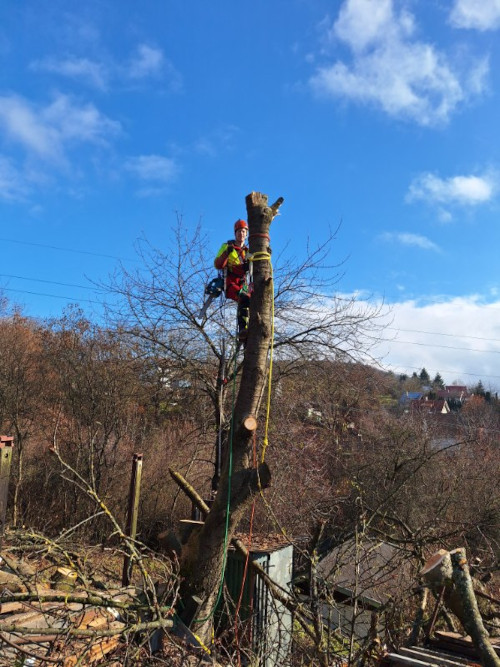
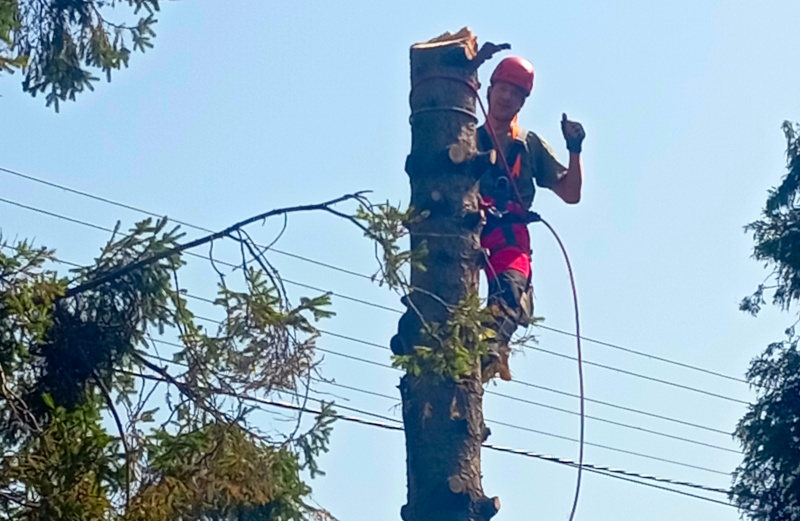
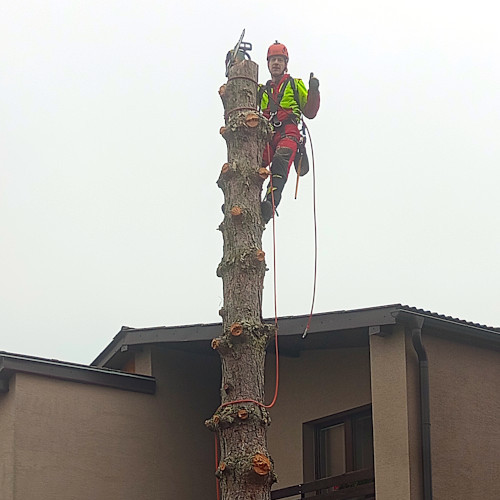
Even when a tree looks simple at first glance, details matter – lean, weight distribution, and available space for a safe fall.
That’s why tree removal cannot rely on “guessing” or simple bottom cutting. It requires experience, proper technique, and full control throughout the entire process.
Tree removal isn’t just about making the tree fall – it’s about making it fall exactly where it should.
Control, step-by-step dismantling, and proper cuts ensure that no damage is done to the house, fence, or surroundings.
That’s also why in practice, trees are often dismantled piece by piece – even when it might seem like they could be felled in one cut.
If you’re curious how these differences affect pricing, take a look at tree removal costs.
Conclusion
Tree removal is not just about making the tree disappear.
It’s about making sure nothing goes wrong – not the house, not the fence, and not the people around it.
Want to know the price?
Send me photos of the tree and surroundings – I’ll give you a realistic estimate without guesswork.
Get a price estimate