Tree work is not just about operating a chainsaw. In my work, I also rely on knowledge gained through professional training focused on safety, climbing, tree pruning, tree risk assessment, rigging, and tree physiology.
In 2026, I completed several courses offered by the International Society of Arboriculture (ISA). These courses help me better assess tree condition, plan safe work procedures, and explain to clients why some interventions benefit a tree while others may cause long-term damage.
Important clarification:
I do not represent myself as an ISA Certified Arborist. The certificates shown below are certificates of completion for individual ISA training courses, not the ISA Certified Arborist certification.
"Safe tree removal or pruning is not only about knowing how to use a chainsaw. It also requires an understanding of tree biology, risk assessment, rope loading, and the long-term effects of pruning."
Why Professional Education Matters in Tree Work
Most trees can be removed or pruned in several different ways. The difference lies in whether the chosen approach is safe, appropriate, and avoids unnecessary damage to the tree or surrounding property.
During tree removal, success depends on risk assessment, fall direction, wood condition, anchor points, and the ability to lower sections in a controlled manner.
When pruning trees, it is important to know where to make cuts, when to prune, and how much of the canopy can be removed without unnecessarily weakening the tree.
When dealing with trees affected by fungi, dead branches, or structural cracks, appearance alone is not enough. The tree's remaining safety margin must also be evaluated.
Completed ISA Training Courses
Introduction to Arboriculture – Climbing
Completed: May 27, 2026
This course focused on the fundamentals of tree climbing, safe movement within the canopy, the use of climbing equipment, and working at height. During hazardous tree removals and pruning operations, it is important not only to reach the canopy but also to remain properly secured and work in a way that minimizes the risk of falling.
In practice, this means planning a safe ascent, using ropes, selecting appropriate anchor points, and wearing suitable personal protective equipment. Tree climbing is not improvised work from a ladder – it is a specialized working technique in its own right.
Introduction to Arboriculture – Safety
Completed: May 28, 2026
Safety is the foundation of professional arboriculture. This course covered job planning, hazard recognition, the use of personal protective equipment, workplace communication, and safe working procedures when operating chainsaws, ropes, and other arboricultural equipment.
Arboricultural safety also involves following industry-recognized principles and standards, including concepts found in standards such as ANSI Z133. These standards address safe arboricultural operations, worksite organization, minimum safe distances, crew communication, working at height, rope systems, chainsaw operation, and protective equipment.
For clients, this means that a safe work procedure is not “wasting time.” It is the difference between a controlled operation and unnecessary risk to people, roofs, fences, roads, vehicles, or utility lines.
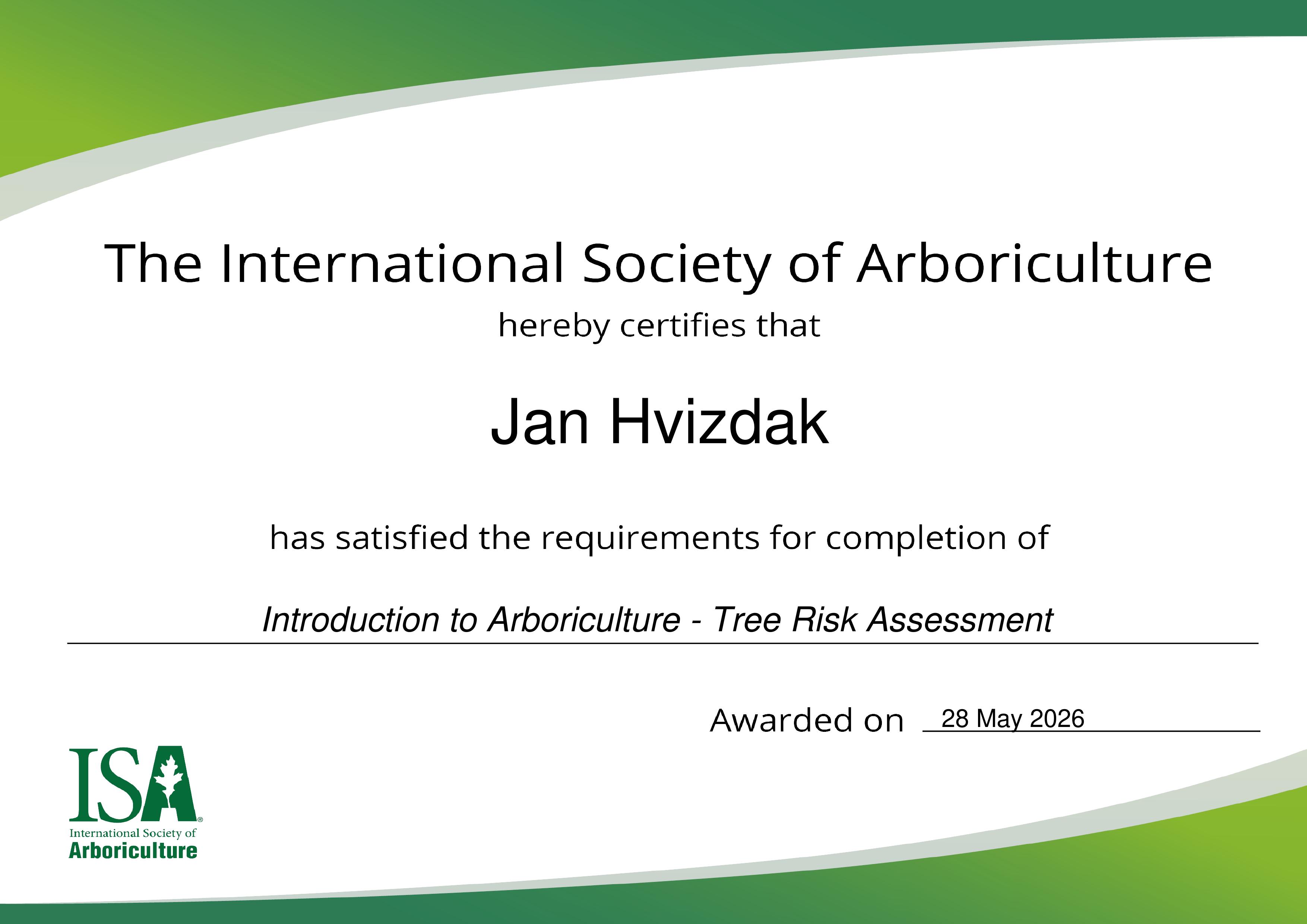
Introduction to Arboriculture – Tree Risk Assessment
Completed: 28 May 2026
This course focused on tree risk assessment. When evaluating a potentially hazardous tree, it is not enough to simply say that it is "large" or "old." Important factors include tree vitality, trunk defects, cracks, cavities, fungal activity, dead branches, lean, root zone condition, and the presence of potential targets around the tree.
A tree standing in the middle of an open field presents a very different level of risk than a tree located above a house, road, parking area, playground, or other frequently used space. Risk assessment therefore considers not only the condition of the tree itself, but also what could be damaged if the tree or one of its parts were to fail.
In practice, this knowledge helps me determine whether removing dead branches is sufficient, whether a reduction prune may be appropriate, or whether it is safer to remove the tree before the situation develops into an emergency.
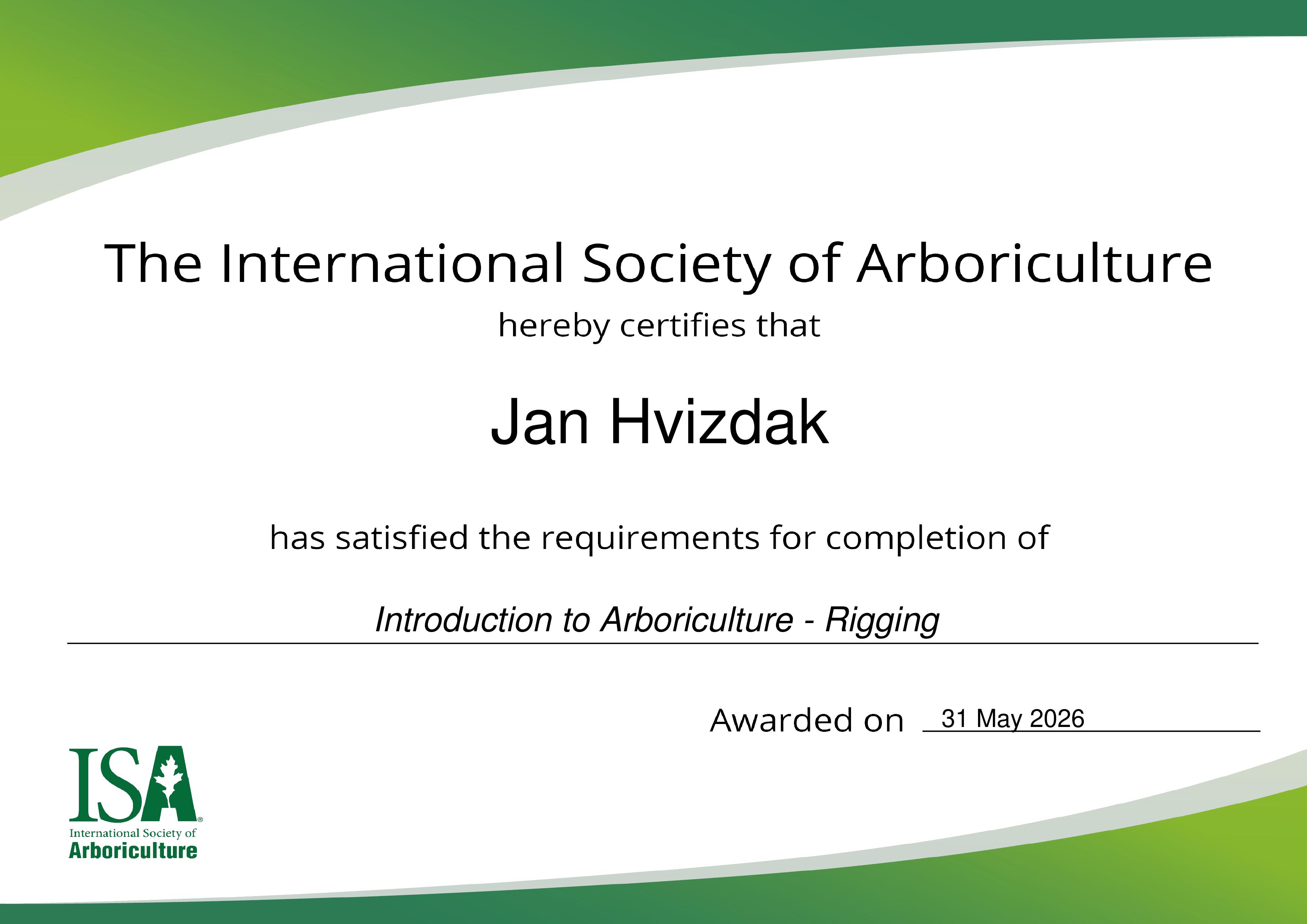
Introduction to Arboriculture – Rigging
Completed: 31 May 2026
Rigging is the controlled lowering of branches or trunk sections using ropes, pulleys, anchor points, and friction devices. It is primarily used when a tree cannot be safely felled in one piece or when structures such as houses, fences, greenhouses, roads, or other obstacles are located beneath the tree.
The course covered rope loading, dynamic forces, rigging point selection, the use of natural and artificial anchor points, and the difference between simply lowering a branch and managing situations where a falling section gains momentum before being arrested by the rope system.
For clients, rigging is often the invisible part of tree work. However, it is what determines whether a heavy branch is placed safely on the ground or ends up damaging a roof, fence, vehicle, or building facade.
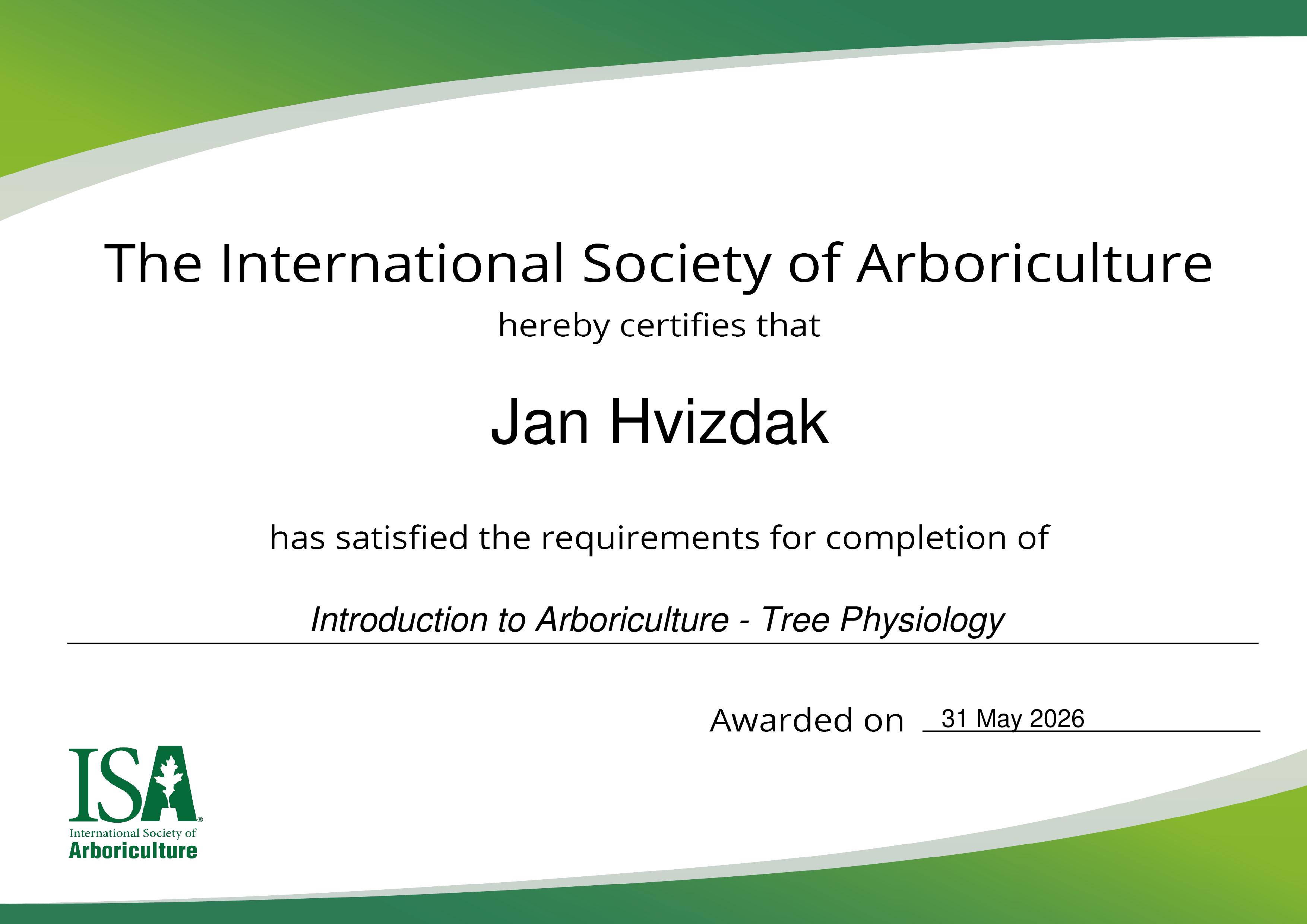
Introduction to Arboriculture – Tree Physiology
Completed: 31 May 2026
Tree physiology explains how a tree functions internally. This course covered photosynthesis, transpiration, water movement through the xylem, carbohydrate transport through the phloem, energy reserves, and tree responses to stress, defoliation, injuries, and pruning.
This knowledge is particularly important when pruning trees. If a tree loses too much of its canopy, photosynthesis is reduced, stored energy reserves begin to be depleted, and the tree may become less capable of defending itself against fungal decay, pests, and drought.
Understanding tree physiology allows me to better explain to clients why reducing a large tree to a low stump is rarely a good idea and why such practices often lead to long-term health, structural, and safety problems.
Introduction to Arboriculture – Principles of Pruning
Completed: 1 June 2026
This course focused on the fundamental principles of proper tree pruning. Important topics included branch collars, branch bark ridges, the difference between correct pruning cuts and flush cuts, and the consequences of leaving long stubs after pruning.
Pruning timing was another key subject. Some trees are best pruned after flowering, while others respond better to pruning during the growing season or dormancy. Whether working with fruit trees, ornamental trees, or large mature specimens, the species, tree condition, and objective of the pruning operation must all be considered.
Proper pruning should benefit the tree rather than unnecessarily weaken it. For this reason, I aim to avoid excessive topping, unnecessary large wounds, and pruning practices that may quickly reduce canopy size but create long-term structural and biological problems.
What These Courses Mean in Practice
A certificate alone will not prune a tree or remove it safely. What matters is how the knowledge gained is applied in real-world situations. For every tree, I consider not only how the work can be carried out, but also why a particular approach is the most appropriate one.
Simple example: a client may want a 20-metre tree reduced to a height of 4 metres so that it is "not so tall anymore."
Professional perspective: such a drastic reduction can remove a large portion of the tree's leaf area, weaken its vitality, trigger excessive sprout growth, and increase the risk of decay developing in large pruning wounds.
Whether performing safety pruning, health pruning, or a hazardous tree removal, it is not enough to consider only the current height of the tree. The tree's condition, species, response to pruning, surrounding obstacles, climbing access, rigging requirements, and potential risks to nearby targets must also be taken into account.
More Than Just a Person with a Chainsaw and a Ladder
At first glance, tree removal may appear to be little more than courage and a powerful chainsaw. In reality, it involves a combination of physics, tree biology, workplace safety, and practical experience.
If a tree is leaning, it is important to understand tension, compression, and the risk of stem failure or splitting.
If a tree contains fungal decay or cavities, its structural condition must be evaluated before climbing.
If obstacles are located beneath the tree, an appropriate rigging strategy must be selected and the movement of every section carefully controlled.
If pruning is required, it is important to know how much of the canopy can be removed without unnecessarily weakening the tree.
"A good arboricultural operation is not the one that looks the most dramatic. It is the one that leaves the tree, the property, and the people safe."
Need a Tree Assessment or Advice on a Safe Work Plan?
Send me photographs of the tree and its surroundings. Based on the situation, I can recommend an appropriate course of action, from health pruning to hazardous tree removal.